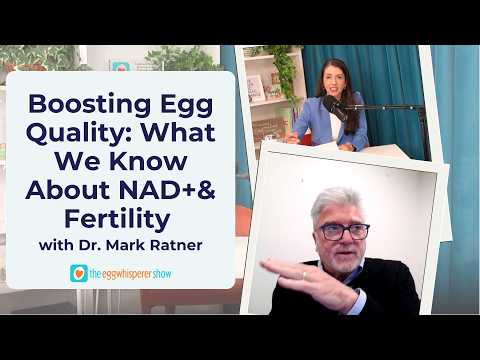
 Plays from YouTube when you click
Egg Whisperer Show · November 5, 2025 · 00:31:20 · 5,501 views
NAD+ and egg quality: a fertility podcast checked: the main claim
Raising NAD with a precursor plus a resveratrol relative can improve egg quality and slow loss of ovarian reserve, and it is safe enough to take for years and into early pregnancy.
Sound biology primer, unproven fertility claim, and a seller doing the explaining. The step from NAD to better eggs rests on mouse work, one unpublished abstract and the speaker's own theories.
The only human fertility result is a conference abstract: 50 women with diminished ovarian reserve, 25 on a NAD-boosting supplement and 25 controls, with fertilization and clinical pregnancy rates reported as doubled. Ratner calls it small, which is fair. Our evidence set holds no published fertility trial of NAD+ or its precursors. The nearest record is NCT05485610, an NMN trial in diminished ovarian reserve with 200 planned participants and no posted results.
Ratner is chief science officer at the company that makes the product, and the description carries a discount code. His adoption figure comes from his own company's survey of about 400 IVF doctors, which measures awareness, not benefit.
NAD+ and egg quality: a fertility podcast checked: what holds up
- Describes NAD as a molecule found in cells throughout the body, built from vitamin B3 forms, with roles in energy production and enzyme activity. That matches how the reviews in our set define it, including the reported decline with age, which the same reviews call poorly understood. Source
- Says boosting NAD is done through precursors such as nicotinamide riboside. That matches what human trials test. In a 65-person randomized trial (PMID:41540253), 14 days of NR or NMN raised circulating NAD+ compared with placebo. It was open-label and measured a blood marker only. Source
- Labels the 50-woman result as small and unpublished, calls long-term use and early-pregnancy use his own theory, and says the male-fertility data are mixed. Those are honest flags for a seller. The male-fertility literature is not in our set, so we could not check it.
- Tells listeners that mice given NAD did not live longer. That fits the 2026 systematic review of 33 human studies, which calls clinical effectiveness for anti-aging inconclusive. Source
NAD+ and egg quality: a fertility podcast checked: what it skips or gets wrong
- Calls the human data on healthspan terrific, citing lower blood pressure, better peripheral vascular disease and less inflammation, "one study after another". The records are thinner. Pooled oral NMN trials found only a slight fall in diastolic blood pressure (PMID:42514320). A 12-week trial in 36 adults found arterial stiffness did not differ significantly from placebo (PMID:36797393). The 2026 review called vascular and functional effects heterogeneous and often null. The inflammation data in our set come from cultured human skin cells (PMID:41779073), not people. Source
- Says NR is shown to raise tissue NAD within weeks and implies it reaches the follicle. The randomized trials measured blood. In mice, most oral NMN and NR was converted by gut bacteria to nicotinic acid instead of being absorbed whole (PMID:40117359). Whether higher blood NAD produces clinical benefit is unproven, and our set has no measurement of NAD in human ovarian follicles. Source
- Builds the case on mouse ovarian-aging studies plus the abstract. The abstract has no named authors in the interview, no live-birth data and no peer review, and a doubling across 25 women per arm could be chance. The registered NMN trial in diminished ovarian reserve (NCT05485610) has status unknown and no results. Source
- Tells patients to keep taking it for years, through early pregnancy, and describes "total safety" at higher trial doses. Pooled NMN trials ran 14 days to 24 weeks in adults, and the authors call for longer trials (PMID:42514320). No trial in our set enrolled pregnant women. In cultured human pancreatic cancer cells and in mice, NMN and NAM gave chemotherapy resistance and supported tumour growth (PMID:41724424). That is not human data, but it is why open-ended use has no safety record behind it. Source
- Borrows credibility from CoQ10, citing six placebo-controlled trials in China that together gave an 84% rise in clinical pregnancy rate. That is a different compound with its own trial base and says nothing about NAD precursors. His explanation that supplement trials are hard to enrol is plausible, but it accounts for the missing evidence without supplying any.
- Says NAD itself cannot be absorbed and that the second ingredient, pterostilbene, raises sirtuins. The first is untested in our records: a registered early phase 1 study of oral NAD+ in 60 healthy adults (NCT07336836) is complete with no results posted. Our set has no human trial of pterostilbene, so that half of the rationale is unchecked. Source
NAD+ and egg quality: a fertility podcast checked: strengths and weak spots
Strengths
- Clear lay explanation of NAD, sirtuins and why eggs need so much cellular energy
- Flags the human fertility result as a small, unpublished abstract
- Calls long-term and early-pregnancy use his own theory
- Short enough to finish in one sitting
Weak spots
- The guest runs the company that sells the product, and the description carries a discount code
- No named authors, journals or trial identifiers for any fertility claim
- Mouse results, an abstract and speaker theory are blended into one story
- The healthspan claim is stronger than the human trials in our set support
- Safety is described as settled with no data on pregnancy or years of use
NAD+ and egg quality: a fertility podcast checked: our recommendation
Skim the first stretch where he explains NAD and sirtuins, and skip the rest. Verify the fertility claim by waiting for the full paper behind the abstract and for results from registered ovarian trials. If you are about to start IVF stimulation or are pregnant, ask your own fertility doctor before taking any NAD precursor, because no trial in our records tested one in pregnancy.