Last updated 2026-07-24
TL;DR
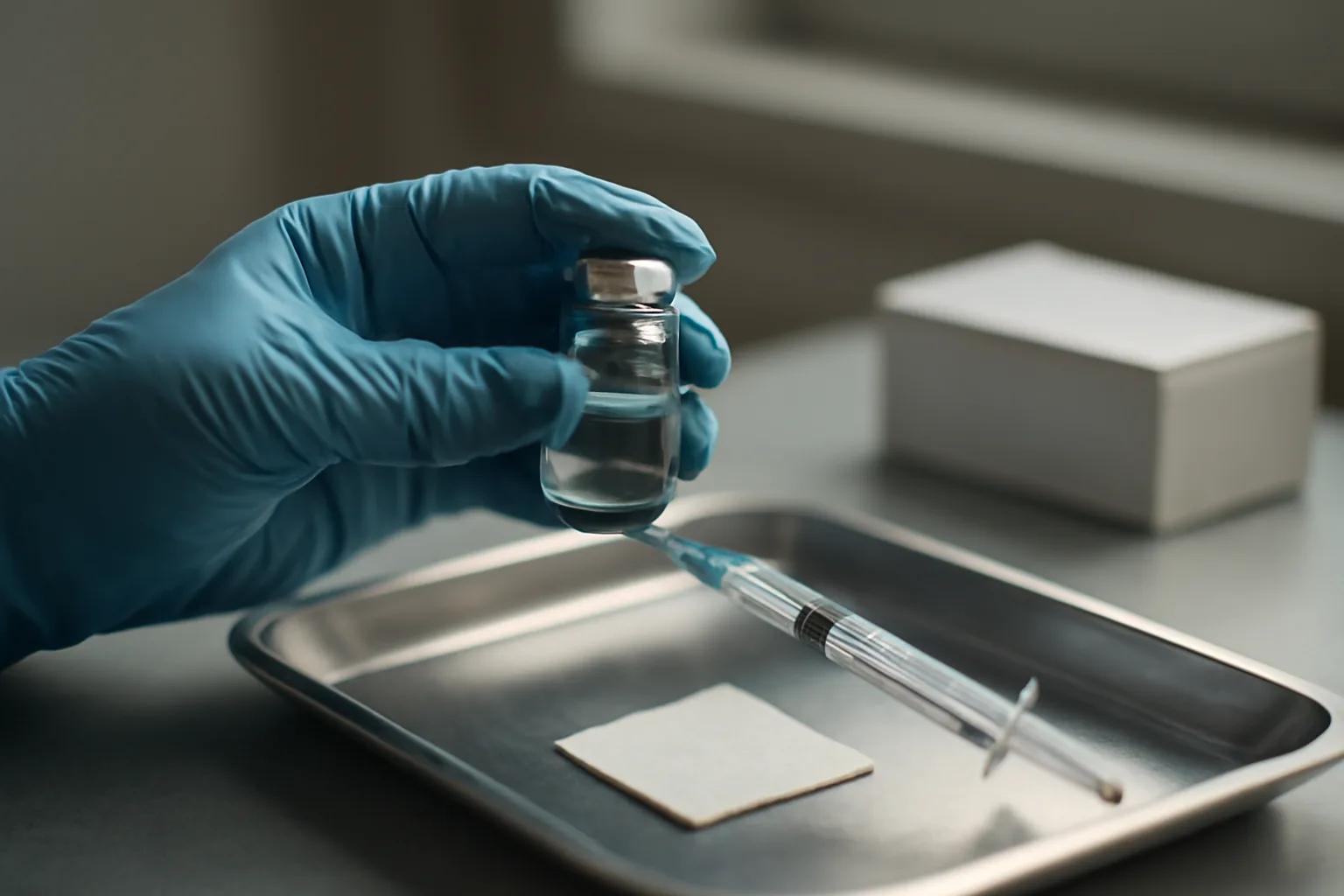
Reconstituting NAD+ means adding sterile bacteriostatic water (or saline) to lyophilized NAD+ powder to make an injectable or nasal solution. Most protocols use 2-3 mL of diluent per 500 mg vial, mixed gently (never shaken), then refrigerated and used within roughly 2-4 weeks. Always use a provider-reviewed, pharmacy-sourced product, not a raw research chemical.
what does it mean to reconstitute NAD+
Reconstitution just means turning a freeze-dried (lyophilized) powder back into a liquid you can actually inject or spray. NAD+ itself is a fragile molecule. It's a dinucleotide, literally two nucleotides joined through their phosphate groups, and that structure was first worked out crystallographically decades ago [1] and confirmed at the molecular level by X-ray studies in the 1970s [2]. Fragile molecules with lots of phosphate bonds don't sit around as stable liquids for long, so manufacturers freeze-dry the compound into a powder and ship it that way. You add sterile liquid right before use. This isn't unique to NAD+. Plenty of injectable peptides and cofactors come as lyophilized powder for the same reason: longer shelf life, easier shipping, less degradation. The tradeoff is that you (or your provider) have to do the mixing step correctly, because a bad dilution ratio or a contaminated needle turns a therapeutic product into a real risk. If you're new to this entirely, it's worth reading about NAD+ peptide basics before you touch a vial, because understanding what you're mixing matters as much as the mixing itself.
what do you need to reconstitute NAD+ powder
You need four things: the lyophilized NAD+ vial itself, a sterile diluent, alcohol swabs, and the right size syringe with a drawing needle. That's it. No special lab equipment. For diluent, the two common choices are bacteriostatic water for injection (water with 0.9% benzyl alcohol as a preservative) or sterile normal saline. Bacteriostatic water is generally preferred for multi-dose vials because the benzyl alcohol slows bacterial growth between uses, which matters since a 500 mg vial is rarely used in a single dose. Saline without a preservative is more of a single-use option. Don't use tap water, distilled water from the pharmacy shelf without checking it's labeled sterile, or anything that isn't explicitly manufactured for injectable use. This is a place where corner-cutting has real consequences, not a place to improvise. A quick supply checklist: - Lyophilized NAD+ vial (100 mg, 500 mg, or 1000 mg are common sizes)
- Bacteriostatic water or sterile saline
- 3 mL syringe with a drawing needle (18-21 gauge) for mixing
- Separate fine-gauge needle (27-31 gauge) for the actual injection if injecting
- Alcohol swabs
- A refrigerator for storage after mixing
how much bacteriostatic water do you add to NAD+
Most 500 mg NAD+ vials get reconstituted with 2 to 3 mL of bacteriostatic water, which lands you around 165-250 mg/mL once mixed. Some providers dilute further, up to 5 mL, for a gentler concentration if a patient reports injection site irritation. There isn't one single FDA-mandated ratio here because NAD+ for injection or nasal use isn't an FDA-approved drug product in the way you'd find in the Drugs@FDA database, so dilution volume is a compounding decision made by the pharmacy or clinician, not a fixed label instruction. Here's a rough reference table based on common compounding practice:
| Vial size | Diluent volume | Approx. concentration | |
|---|---|---|---|
| 100 mg | 1-2 mL | 50-100 mg/mL | |
| 500 mg | 2-3 mL | 165-250 mg/mL | |
| 1000 mg | 3-5 mL | 200-330 mg/mL | If you're working with a specific product, the concentration and volume should already be specified by the compounding pharmacy or the provider who prescribed it. If you're unsure, ask before you mix, don't guess. For dosing math once it's mixed, a NAD+ injection dosage calculator is more reliable than eyeballing it, especially early on when you're still finding your dose. |
what is the step by step process to reconstitute NAD+
The mixing itself takes about two minutes once you have supplies laid out. Here's the sequence: 1. Wash your hands and wipe down your work surface. 2. Swab the rubber stopper on both the NAD+ vial and the diluent vial with alcohol and let them air dry for a few seconds. 3. Draw the correct amount of bacteriostatic water into your syringe (2-3 mL for a 500 mg vial, per your provider's instruction). 4. Insert the needle through the center of the NAD+ vial's stopper at a slight angle, and inject the diluent slowly down the inside wall of the vial, not directly onto the powder. 5. Remove the needle and gently swirl or roll the vial between your palms. Do not shake it. 6. Let it sit for a minute or two. NAD+ powder can be slow to fully dissolve; keep gently swirling until the solution looks clear, with no visible clumps or cloudiness. 7. Label the vial with the date it was mixed. 8. Refrigerate immediately. The "don't shake it" instruction isn't precious lab etiquette. Vigorous agitation introduces air bubbles and can physically stress a molecule that's already sensitive to degradation, and there's decades of biochemistry literature built around the fact that NAD+ handling conditions (pH, temperature, oxidation state) change its behavior in solution [3]. Gentle is the right speed here.
how do you know if the NAD+ solution mixed correctly
A properly reconstituted NAD+ solution should look clear to pale yellow, with zero particles floating in it. That's the visual check, and it takes five seconds. If you see cloudiness, clumps, or any discoloration beyond a light yellow tint, don't use it. That's a sign either the powder didn't fully dissolve, the vial was contaminated, or something in the mixing process went wrong. Toss it and start over with a new vial if you have one, or call the pharmacy that supplied it. NAD+ in solution is also somewhat oxygen and light sensitive, which is part of why the biochemistry literature spends so much time on ways to regenerate or stabilize the reduced and oxidized forms of the molecule in lab settings, using everything from electrochemical methods [4] to enzyme-loaded nanoreactors [5] to photocatalytic film electrodes [6]. None of that lab chemistry applies to your kitchen counter, but it's the reason storage instructions (dark, cold, sealed) aren't arbitrary. The molecule genuinely degrades faster with heat, light, and air exposure.
how long does reconstituted NAD+ last and how should you store it
Once mixed, reconstituted NAD+ is typically good for 2 to 4 weeks if kept refrigerated at 36-46°F (2-8°C), though exact stability varies by compounding pharmacy and formulation, so check the label or ask the pharmacy that prepared it. Keep it out of direct light; some people keep the vial in its original box or wrapped in foil in the fridge door. Never freeze reconstituted NAD+. Freezing and thawing cycles can degrade the molecule and also risks cracking the vial. Also don't leave it at room temperature for extended periods; a few minutes while drawing a dose is fine, but it shouldn't sit out on a counter for hours. Before each use, do the visual check again: clear, no particles, consistent color. If it starts looking off partway through the vial's expected shelf life, don't use the rest. It's a cheap thing to throw away compared to the alternative.
can you reconstitute NAD+ with saline instead of bacteriostatic water
Yes, sterile saline works, but it changes how you should treat the vial afterward. Bacteriostatic water contains benzyl alcohol as a preservative, which suppresses bacterial growth across multiple draws from the same vial over its shelf life. Plain sterile saline has no such preservative. If a provider or pharmacy reconstitutes with saline, that vial is generally meant for more limited use, ideally drawn once and used promptly, not kept as a multi-dose vial sitting in the fridge for weeks. Some people are also advised to avoid benzyl alcohol specifically (it's not recommended in certain populations, including infants, though that's not the relevant population for NAD+ therapy). If your provider chose saline, ask why, since it usually signals a shorter intended use window.
is it safe to reconstitute NAD+ at home
It's common practice, and plenty of patients on hormone therapy, peptide protocols, and B12 injections do their own reconstitution and injections at home under a provider's guidance. The real safety issues aren't the mixing chemistry, they're sourcing and technique. On sourcing: NAD+ is not an FDA-approved drug in the traditional sense. It reaches patients through compounding pharmacies operating under federal compounding law. Under 21 U.S.C. § 353a, licensed pharmacists can compound a drug for an individual patient based on a valid prescription, using bulk substances that meet specific criteria. The FDA maintains lists of bulk drug substances that can and cannot be used this way under 21 CFR 216.23 for 503A pharmacies and 21 CFR 216.24 for 503B outsourcing facilities, and it separately maintains a running list of substances nominated for compounding use that haven't necessarily been added or approved. This matters because it means quality and legitimacy vary a lot by supplier. A product from a licensed, 503A or 503B compounding pharmacy reviewed by a prescribing provider is a different animal from a vial bought off a research chemical website with no chain of custody. On technique: use a new sterile needle every time, never share vials or syringes between people, rotate injection sites if you're doing subcutaneous or intramuscular dosing, and don't reuse needles even on the same vial across days. These are the same basic rules that apply to any home injection therapy.
how does reconstituted NAD+ get administered, injection vs nasal vs IV
Once mixed, the same reconstituted solution can typically be used for subcutaneous injection or drawn into a nasal spray applicator, depending on what your provider prescribed, though the concentration and volume per dose differ by route. Subcutaneous injection is the most common home-use route. A small volume, often 0.25-1 mL depending on the concentration, is injected into fatty tissue (abdomen, thigh) using a fine needle. It's straightforward, doesn't require IV access, and most people tolerate it, though some report a burning or flushing sensation at the injection site or during administration, particularly at faster injection speeds. Nasal spray uses a lower per-dose volume, delivered as a mist rather than an injection. Because nasal mucosa is highly vascular, some proponents argue this gets NAD+ into circulation without a needle, though there's very little independent nasal-bioavailability data specifically for NAD+ itself. If you want a closer comparison of the two, see NAD+ nasal spray vs injection. IV NAD+ delivers the compound straight into the bloodstream, bypassing absorption questions entirely, but requires a clinical setting, a trained provider to place the line, and a session that runs one to several hours because rapid IV push of NAD+ is associated with chest tightness and cramping at high infusion rates in clinical reports. It's also the most expensive route per session. None of these delivery methods has been compared head-to-head in a rigorous published bioavailability trial in humans that we're aware of. Choice mostly comes down to convenience, cost, and tolerance for needles versus IV time versus nasal application, not proof that one route raises blood or tissue NAD+ levels more than another. For dosing specifics once you've picked a route, see NAD+ 500mg and NAD+ peptide injection protocols.
how does reconstituted NAD+ compare with oral precursors like NMN and NR
Reconstituted NAD+ (injection, nasal) delivers the intact molecule directly, bypassing the gut. Oral precursors like nicotinamide mononucleotide (NMN) and nicotinamide riboside (NR) instead give your body raw material and let its own salvage pathway build NAD+ internally. NAD+ biosynthesis and the salvage pathway are well described in the biochemistry literature going back decades [7], and the pathway is well conserved enough that it's been mapped even in microbial systems [8]. The practical tradeoff: oral precursors are cheap, easy, and don't require needles, but NAD+ itself is a large, charged molecule that doesn't cross the gut wall intact in meaningful amounts, which is exactly why precursor strategies exist instead of oral NAD+ pills. Injection and nasal routes skip that absorption problem but cost more and require more handling (reconstitution, storage, sometimes needles). Neither route has strong, independent, head-to-head human trial data proving superior long-term outcomes. What's well established is that a functioning NAD+/NADH redox system underlies core cellular energy metabolism, a role recognized as far back as classic reviews describing NAD+ as "beyond a redox coenzyme" [3] and as a metabolic regulator tied to transcription and longevity pathways in cell biology [9]. What's not established is that boosting NAD+ from any external source, whether IV, injection, nasal, or oral precursor, extends healthy human lifespan. That's a genuinely open question, not a marketing footnote.
what does the research actually say about NAD+ and aging
NAD+ levels are well documented to decline with age, and there's a real, growing research base on why that matters for cellular function. A 2025 review in Trends in Endocrinology and Metabolism laid out current thinking on NAD+ as a central metabolic regulator [10]. Separately, NAD+ biosynthesis pathways have been studied specifically in the context of metabolism, aging, and neurodegeneration [7], and a 2003 review in Current Opinion in Cell Biology already framed NAD+ as "a metabolic regulator of transcription, longevity and disease" [9], showing this isn't a new idea, just one that's picked up momentum. Where the science gets more specific and more interesting: a 2025 study in ACS Nano looked at targeting senescent cells by manipulating intracellular NAD+ recycling, aimed at reducing senescence-associated phenotypes [11]. NAD+-related pathways have also been studied in kidney stress resistance via PGC-1α signaling [12], in nonalcoholic fatty liver disease where NAD+ shows therapeutic potential in preclinical models [13], and in cardiovascular disease mechanisms, including cardiac remodeling and aging [14] [15]. NAD+ also has a documented role in immune function, covered in a 2021 Frontiers in Immunology editorial [16] and in a review connecting tryptophan metabolism to NAD+ and immunity [17]. That's a genuinely wide research footprint. But nearly all of the mechanistic and disease-model work is in cell cultures or animal models, not large human trials proving that supplementing NAD+ (by any route) extends healthspan or lifespan in people. The honest read: NAD+ decline with age is real and well supported. NAD+'s role in specific diseases (liver, kidney, cardiovascular, immune, even leukemia metabolism [18]) is an active and legitimate research area. Whether restoring NAD+ levels externally reverses aging or meaningfully extends human life is not something current evidence establishes. Anyone selling you certainty on that point is overselling the data.
where should you get NAD+ for reconstitution
Get it from a compounding pharmacy operating through a licensed provider, not a bulk supplier marketing directly to consumers as a "research chemical." The distinction matters legally and practically. Pharmacies compounding under Section 503A of the FD&C Act [21 U.S.C. § 353a] are required to use bulk substances that meet the FDA's specific criteria for that pathway, and outsourcing facilities under 503B have their own separate substance list [21 CFR 216.24]. A provider-reviewed process means someone with clinical training checked your history, discussed the route, and is on record prescribing it. If you're still figuring out where to start, where to get NAD+ walks through what a legitimate sourcing chain actually looks like. NAD+ Rx works with a provider-reviewed process and a fulfilling pharmacy partner for injection and nasal spray forms, rather than selling raw powder direct to consumers with no clinical oversight, which is the model worth looking for regardless of which company you ultimately use.
Frequently asked questions
How much bacteriostatic water do I use for a 500mg NAD+ vial?
Most compounding pharmacies recommend 2-3 mL of bacteriostatic water for a 500 mg vial, giving a concentration around 165-250 mg/mL. Some protocols use up to 5 mL for a more diluted, gentler solution. Follow your specific pharmacy's instructions since dilution volume isn't standardized by the FDA for this compounded product.
Can I shake the vial to mix NAD+ powder?
No. Shake gently by rolling the vial between your palms or swirling it, never shake vigorously. Vigorous shaking introduces air bubbles and can stress the molecule, and NAD+ is already known to be sensitive to oxidation and handling conditions in solution. Let it sit and swirl periodically until fully clear.
How long is reconstituted NAD+ good for?
Typically 2 to 4 weeks when refrigerated at 36-46°F (2-8°C), though exact shelf life depends on the compounding pharmacy's formulation and whether bacteriostatic water or plain saline was used. Check the label from your specific supplier. Discard immediately if the solution turns cloudy or shows particles.
Do I need to refrigerate NAD+ after reconstituting it?
Yes, refrigerate it immediately after mixing and keep it refrigerated between uses. Never freeze it. Keep it away from direct light. Room temperature exposure should be limited to the brief time it takes to draw a dose, not extended storage.
Is bacteriostatic water or saline better for reconstituting NAD+?
Bacteriostatic water contains a preservative (benzyl alcohol) that helps a multi-dose vial stay usable over weeks. Plain sterile saline has no preservative, so vials mixed with saline are generally meant for more immediate or single-session use rather than weeks of repeated draws.
Is NAD+ injection or nasal spray FDA-approved?
No. NAD+ for injection or nasal use isn't an FDA-approved drug product listed in the Drugs@FDA database. It reaches patients through pharmacy compounding under federal law (21 U.S.C. § 353a), which requires a valid prescription and a licensed compounding pharmacy, not consumer-direct sale.
What does properly mixed NAD+ solution look like?
Clear to pale yellow, with no visible particles, clumps, or cloudiness. If the solution looks cloudy, discolored beyond a light yellow, or has floating material, don't use it. Discard it and start with a fresh vial, or contact the pharmacy that supplied it.
Can reconstituted NAD+ be used for both injection and nasal spray?
The same reconstituted vial can sometimes serve either route depending on what your provider prescribed, but concentration and per-dose volume differ by route. Don't improvise a switch between forms without checking with the prescribing provider, since dosing math changes.
How is NAD+ different from NMN or NR supplements for boosting NAD+ levels?
NAD+ injection or nasal spray delivers the molecule itself directly, bypassing digestion. NMN and NR are oral precursors that your body converts into NAD+ through its salvage pathway. NAD+ itself doesn't absorb well orally, which is why precursor supplements exist as an oral alternative rather than oral NAD+ pills.
Does raising NAD+ levels actually slow aging or extend lifespan?
That's not established in humans. NAD+ levels reliably decline with age, and NAD+ is tied to real disease mechanisms in kidney, liver, cardiovascular, and immune research, mostly in cell and animal models. Whether externally raising NAD+ (any route) extends human healthspan or lifespan hasn't been proven in large human trials.
Why does NAD+ come as a powder instead of a ready-to-use liquid?
NAD+ is a fragile dinucleotide molecule that degrades faster in liquid form, especially with heat, light, and oxygen exposure. Freeze-drying (lyophilizing) it into powder extends shelf life and stability during shipping and storage. Reconstitution right before use minimizes the time the molecule spends in a degradable liquid state.
What size needle do I need to reconstitute and inject NAD+?
Use a larger needle (18-21 gauge) to draw the diluent into the vial and mix, since it's more efficient for pushing liquid through the stopper. For the actual subcutaneous injection, switch to a much finer needle (27-31 gauge) for comfort and precision. Never inject with the mixing needle.
Can I reuse an NAD+ vial across multiple days?
Yes, if it was reconstituted with bacteriostatic water (which contains a preservative) and stored refrigerated, most protocols allow use across 2-4 weeks. Use a fresh sterile needle for every draw, never share the vial between people, and check for cloudiness before each use.
Sources
- PubMed, Crystallization of Nicotinamide Adenine Dinucleotide (J Biol Chem, 1964): Early crystallographic work established the physical structure of NAD+ as a fragile dinucleotide.
- PubMed, Molecular structure of nicotinamide adenine dinucleotide (Nature, 1975): X-ray structural analysis confirmed the molecular structure of NAD+ in the 1970s.
- PubMed, Nicotinamide adenine dinucleotide: beyond a redox coenzyme (Org Biomol Chem, 2007): NAD+'s behavior and stability in solution depends on redox state and handling conditions.
- PubMed, Electrochemical regeneration of nicotinamide adenine dinucleotide (Biochim Biophys Acta, 1975): Electrochemical methods have been studied as a way to regenerate NAD+ in laboratory settings.
- PubMed, Enzyme-loaded nanoreactors for continuous NAD+ regeneration (Angew Chem Int Ed, 2021): Enzyme-loaded nanoreactor systems enable continuous NAD+ regeneration in artificial metabolic systems.
- PubMed, Regeneration of NADP by chlorophyll a-coated TiO2 film electrode (ACS Appl Bio Mater, 2021): Photocatalytic film electrode systems have been developed to regenerate NADP in vitro.
- PubMed, NAD+ biosynthesis in metabolism, aging, and neurodegeneration (Holist Nurs Pract, 2021): NAD+ biosynthesis pathways are described in relation to metabolism, aging, and neurodegeneration.
- PubMed, NAD biosynthesis and pyridine nucleotide cycle metabolism in microbial systems (Microbiol Rev, 1980): The NAD+ biosynthesis and salvage pathway is conserved and has been mapped in microbial systems.
- PubMed, NAD+, a metabolic regulator of transcription, longevity and disease (Curr Opin Cell Biol, 2003): NAD+ is described as a metabolic regulator connected to transcription, longevity, and disease pathways.
- PubMed, NAD+ (oxidized form) review (Trends Endocrinol Metab, 2025): A 2025 review outlines current understanding of NAD+ as a central metabolic regulator.
- PubMed, Targeting senescence via intracellular NAD+ recycling (ACS Nano, 2025): A 2025 study targeted senescent cell phenotypes by manipulating intracellular NAD+ recycling.
- PubMed, PGC-1α, NAD+ and renal stress resistance (Nephron, 2017): NAD+ and PGC-1α signaling are linked to kidney stress resistance in research models.
- PubMed, Therapeutic potential of NAD+ for nonalcoholic fatty liver disease (Hepatology, 2016): NAD+ shows therapeutic potential for nonalcoholic fatty liver disease in preclinical research.
- PubMed, Effects of NAD+ in cardiovascular diseases (Genes Dis, 2022): NAD+ mechanisms are studied in relation to cardiovascular disease and therapeutic potential.
- PubMed, NAD+ in cardiac remodeling and aging (Mini Rev Med Chem, 2022): NAD+ pathways are implicated in cardiac remodeling and aging processes.
- PubMed, The versatile role of NAD in immunity (Front Immunol, 2021): NAD+ has a documented role in immune system function per this 2021 editorial.
- PubMed, Tryptophan and NAD in immunity (Int J Tryptophan Res, 2017): Tryptophan metabolism connects to NAD+ production and immune function.
- PubMed, NAD salvage and metabolic vulnerability in acute myeloid leukemia (Transl Cancer Res, 2026): NAD+ salvage pathway dependency is linked to metabolic vulnerability and treatment sensitivity in leukemia research.
- Cornell Law School Legal Information Institute, 21 U.S.C. § 353a: Federal law governs pharmacy compounding of drugs like NAD+ for individual patients under a valid prescription.
- eCFR, 21 CFR 216.23 (503A Bulks List): The FDA maintains a list of bulk drug substances permitted for 503A pharmacy compounding.
- eCFR, 21 CFR 216.24 (503B Bulks List): The FDA maintains a separate bulk substances list for 503B outsourcing facilities.
- FDA, Bulk Drug Substances Nominated for Use in Compounding: The FDA tracks substances nominated for compounding use that are not necessarily approved for that use.
- FDA, Bulk Drug Substances Used in Compounding Under Section 503A: The FDA outlines criteria bulk substances must meet to be used in 503A compounding.
- FDA, Drugs@FDA database: NAD+ injection or nasal products are not listed as FDA-approved drug products in this database.