Last updated 2026-07-25
TL;DR
NAD+ is typically injected subcutaneously with an insulin syringe (28-31 gauge) into the abdomen or thigh, or intramuscularly for larger volumes. Draw the dose, rotate injection sites, expect mild flushing or warmth, and never combine with alcohol swabs still wet. Human longevity benefit from raising NAD+ isn't established, though age-related decline is well documented.
what is NAD+ and why do people inject it instead of taking a pill?
NAD+ (nicotinamide adenine dinucleotide) is a coenzyme every cell needs to run energy metabolism, DNA repair, and a family of signaling reactions tied to aging biology. It was first crystallized back in 1964 [1], and researchers have been characterizing its molecular structure and redox chemistry for decades since [2][3]. The reason people skip capsules and reach for a syringe comes down to bioavailability. NAD+ is a large, charged molecule. Oral NAD+ gets broken down substantially in the gut before it reaches the bloodstream intact, which is part of why the supplement market shifted toward precursors like NMN and NR that the body converts into NAD+ internally. Injection routes (subcutaneous, intramuscular, or IV) bypass first-pass digestion, so more of the compound reaches circulation. That doesn't mean injected NAD+ is proven superior for health outcomes. It means it changes how much of the molecule shows up in your blood, not necessarily what your cells do with it long-term. If you want the fuller comparison of routes and precursor chemistry, see NAD+ dosage and NAD+ vs NAD+ peptide.
what supplies do I need before injecting NAD+?
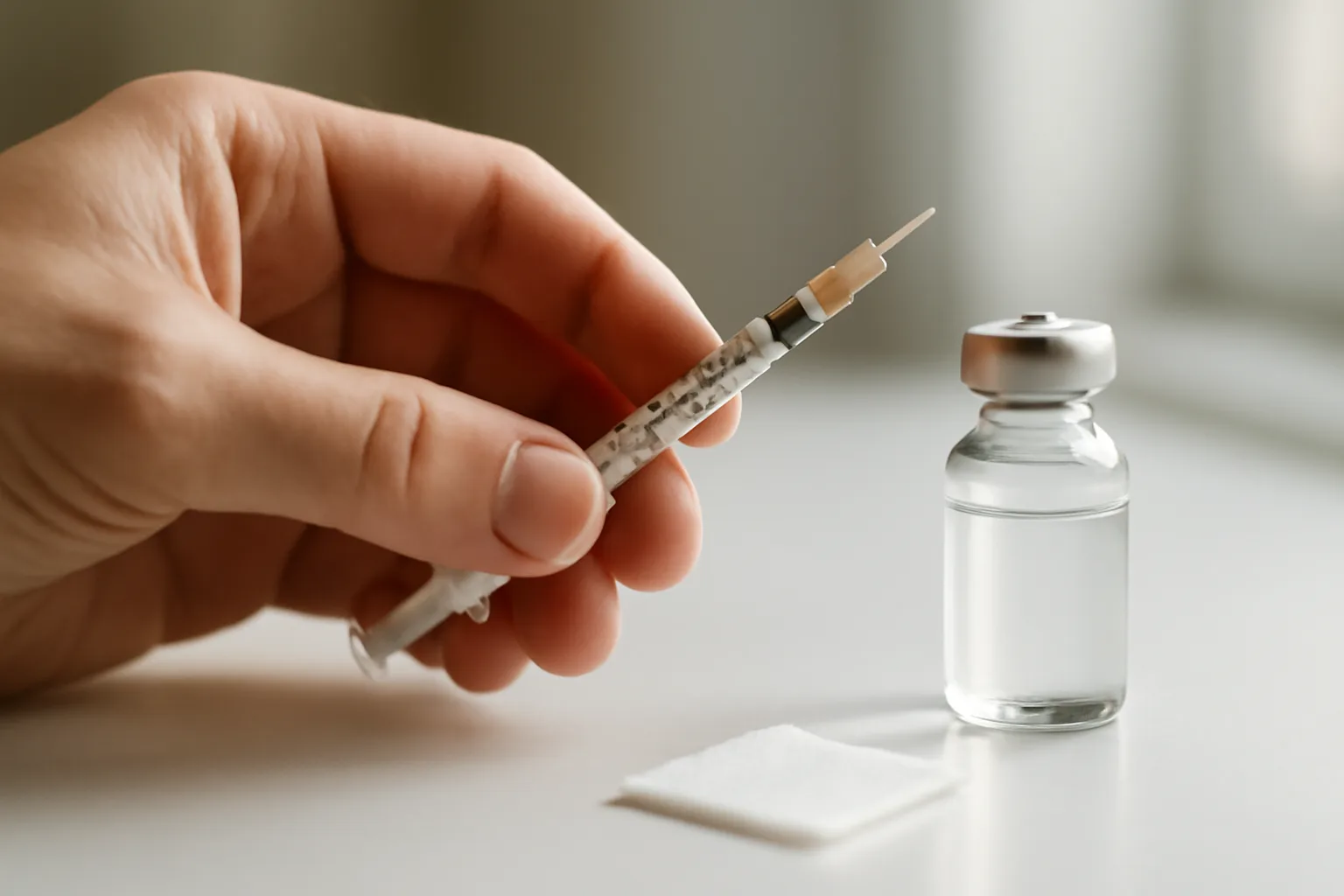
A basic subcutaneous NAD+ injection setup needs: an insulin syringe (typically 0.5 mL or 1 mL, 28-31 gauge), alcohol swabs, a vial of reconstituted NAD+ (or lyophilized powder plus bacteriostatic water if you're mixing it yourself), a sharps container, and clean hands. If your provider has you doing intramuscular injections instead (more common for larger total doses), you'll want a longer needle, usually 22-25 gauge, 1 to 1.5 inches, because IM injections need to reach muscle tissue rather than the fat layer just under skin. Never reuse needles. Never share vials across people. Store reconstituted NAD+ in the refrigerator and check the product's guidance on shelf life after mixing, since bacteriostatic water only slows microbial growth, it doesn't stop degradation of the compound itself indefinitely.
how do I prepare and draw up an NAD+ injection dose?
First, wipe the vial top with an alcohol swab and let it dry (this matters more than people think; injecting through wet alcohol can sting and theoretically drag residue through the needle track). Draw air into the syringe equal to your dose volume, inject that air into the vial to equalize pressure, then invert the vial and draw your dose slowly to avoid bubbles. Tap the syringe to move any air pockets to the top and expel them before injecting. Dosing itself varies a lot by protocol, from roughly 25 mg up to 100+ mg per subcutaneous injection in the regimens providers commonly use, though there's no universal clinical standard the way there is for, say, insulin. If you're unsure what dose your provider recommended actually translates to on the syringe barrel, use a NAD+ dosage calculator to double-check your math before you inject anything.
where on my body should I inject NAD+?
For subcutaneous injections, the standard rotation is the abdomen (at least two inches from the navel), the front or outer thigh, or the back of the upper arm if someone else is administering it. For intramuscular injections, the ventrogluteal area (hip) or the deltoid (upper arm muscle) are typical sites. Rotating sites matters. Injecting the same quarter-inch of skin repeatedly causes local irritation, scar tissue (lipohypertrophy), and can make future injections less predictable in how they absorb. A simple pattern: right abdomen, left abdomen, right thigh, left thigh, repeat. For a full site-by-site breakdown with diagrams and how to judge fat pad thickness before choosing a site, see NAD+ injection sites.
subcutaneous vs intramuscular vs IV: which injection route is right for me?
| Route | Needle | Absorption speed | Typical use case | Discomfort | |
|---|---|---|---|---|---|
| Subcutaneous (SubQ) | 28-31G, 0.5in | Slower, steadier | Home self-injection, daily/frequent dosing | Mild stinging, warmth | |
| Intramuscular (IM) | 22-25G, 1-1.5in | Faster than SubQ | Clinic or home with training, larger volumes | More noticeable, brief | |
| IV infusion | Catheter, clinical setting only | Fastest, full dose reaches blood immediately | Clinic-administered, higher total doses | Flushing, nausea, requires monitoring | |
| Intranasal spray | N/A | Variable, absorbed through nasal mucosa | Home use, no needles | Minimal, some nasal irritation | SubQ is what most people do at home because it's forgiving of small technique errors and the slower absorption tends to mean less of the flushing and nausea people report with fast IV pushes. IM gets more of the dose in faster but stings more and needs more precise site selection to avoid nerves. IV NAD+ is administered in clinical settings only, over one to several hours, and is the route most associated with the flushing, chest tightness, or cramping people describe, especially if the infusion runs too fast. Nasal NAD+ sprays are the newest home option and avoid needles entirely, though how much reaches systemic circulation via nasal mucosa versus how much is swallowed and degraded in the gut is not well quantified in public human data. No published human trial directly compares long-term health outcomes across these four routes head-to-head. Route selection right now comes down to convenience, tolerance, and what your provider is comfortable prescribing, not proven superiority of one path into your bloodstream. |
how much does NAD+ injection actually raise blood or tissue NAD+ levels?
This is the honest gap in the field. We have strong basic-science evidence that NAD+ is a load-bearing molecule in cellular energy production, DNA repair enzymes (PARPs), and sirtuin signaling, reviewed extensively in the biology and disease literature [4]. We have far less human data quantifying exactly how much a 50 mg subcutaneous shot moves NAD+ concentration in a specific tissue over a specific timeframe. Much of the mechanistic case for NAD+ injections rests on cell and animal work: NAD+ decline is linked to reduced stress resistance in kidney cells [5], altered redox handling after ischemic stroke in neurons [6], and metabolic dysfunction in liver disease models [7]. A 2025 study used a NAD+-recycling nanoparticle strategy to reduce markers of cellular senescence in lab models [8], which is promising mechanism-level work, not a human aging trial. Separately, a 2025 review in Trends in Endocrinology and Metabolism describes NAD+ as "nicotinamide adenine dinucleotide, oxidized form" in its role as a central metabolic cofactor [9], underscoring that most of what's confirmed is biochemical function, not therapeutic dosing outcomes in people.
how often should I inject NAD+, and for how long?
Protocols vary widely because there's no FDA-approved dosing schedule for NAD+ as an anti-aging or energy therapy. Clinics commonly run daily or every-other-day subcutaneous injections for an initial stretch of two to four weeks, then step down to two or three times a week for maintenance. There's no clinical consensus on optimal cycle length, largely because there's no large controlled human trial establishing one. Some providers recommend periodic breaks; others run continuous maintenance dosing indefinitely. If you want the fuller breakdown of how providers structure loading phases versus maintenance, see NAD+ cycle length. What you should expect to feel, and when, differs by person and isn't well mapped in controlled studies. For a realistic week-by-week account of subjective effects people report, see NAD+ timeline: what to expect.
what side effects should I expect from an NAD+ injection?
The most commonly reported side effects from subcutaneous or intramuscular NAD+ injections are local: redness, mild swelling, or a dull ache at the injection site for a day or two. Some people report flushing, a warm or tight feeling in the chest, or mild nausea, particularly with faster IM injections or if the dose is pushed in too quickly. Systemic effects like headache or fatigue the day after are reported anecdotally by users and providers but aren't well characterized in controlled human trials at the doses commonly used in wellness clinics. If you experience sharp pain, spreading redness, fever, or numbness beyond the injection site, stop and contact your provider. Those aren't typical NAD+ reactions and could indicate infection or nerve involvement from technique error. One underappreciated risk factor: NAD+ is a coenzyme, not an inert filler, and its part in oxidative pathways means product purity matters. Compounded NAD+ products fall under FDA's bulk drug substance framework for 503A and 503B pharmacies [10][11], which is a separate regulatory question from clinical efficacy, but it does mean sourcing quality varies by compounding pharmacy.
is NAD+ injection legal, and does the FDA regulate it?
NAD+ itself has no FDA-approved drug application listed in the Drugs@FDA database [12], meaning there's no NAD+ product that has gone through the standard new-drug approval pathway for a specific indication the way, say, metformin has. What exists instead is a compounding pharmacy framework. Under 21 U.S.C. 353a, licensed pharmacies can compound drugs for individual patients based on a prescription, provided the substance is on FDA's bulk drug substance list or otherwise qualifies [13]. NAD+ has been the subject of FDA's bulk drug substance nomination and review process for 503A compounding [14], and there's a separate bulks list for 503B outsourcing facilities under 21 CFR 216.24 [11], versus 503A under 21 CFR 216.23 [10]. Practically: this means NAD+ injections you get from a clinic or telehealth provider are typically compounded under prescription, not sold over the counter as an approved drug. That's a meaningfully different regulatory status than a supplement capsule, and it's why a prescriber's involvement (and a legitimate, licensed compounding pharmacy) actually matters here, more than as paperwork.
can I inject NAD+ at home, or do I need a clinic?
Subcutaneous NAD+ injections are commonly self-administered at home once a provider has prescribed a dose and confirmed you understand technique, similar to how people self-inject insulin or certain fertility medications. IV NAD+ infusions require clinical administration because of the volume, rate control, and monitoring involved. A provider-reviewed pathway (a clinician evaluates your history, writes the prescription, and a licensed pharmacy fills it) is the standard, safer structure compared with buying unregulated NAD+ powder online and reconstituting it yourself with no oversight. NAD+ Rx's model follows the reviewed-prescription approach, with injection and nasal spray options fulfilled through a licensed pharmacy partner rather than compounded in-house. If home self-injection makes you nervous, intranasal NAD+ spray is a reasonable no-needle alternative for people who want the route without the technique learning curve, though as noted above, comparative absorption data between nasal and injected NAD+ in humans is thin.
does raising NAD+ levels actually slow aging or extend healthspan?
This is the single most important thing to understand before spending money on NAD+ injections: the decline of NAD+ with age is well documented at the cellular and biochemical level [4][9], but the leap from "NAD+ declines with age" to "restoring NAD+ extends human healthspan or lifespan" has not been established in controlled human trials. The mechanistic case is genuinely interesting. NAD+ is tied to cardiovascular remodeling and aging processes in reviewed literature [15], cardiovascular disease pathways more broadly [16], nonalcoholic fatty liver disease models [7], and immune function, including a 2021 editorial describing its "versatile role" in immunity [17] and a 2017 review of its relationship with tryptophan metabolism in immune signaling [18]. NAD+ also shows up in stem cell pluripotency research [19] and even acute myeloid leukemia metabolism, where NAD+ salvage pathways create a therapeutic vulnerability researchers are trying to exploit [20]. What's missing is the human longevity trial: a large, randomized, controlled study showing that people who raise their NAD+ levels through any route live longer or measurably healthier than people who don't. That trial doesn't exist yet. Anyone selling NAD+ injections as a proven longevity intervention is overselling the evidence base. Anyone dismissing it as pure snake oil is ignoring a genuinely active and legitimate area of cell biology research. The honest position is in between: promising mechanism, unproven human outcome.
Frequently asked questions
How do I inject NAD+ subcutaneously at home?
Clean the injection site and vial top with alcohol, let it dry, draw your prescribed dose into an insulin syringe (28-31 gauge), pinch a fold of skin at the abdomen or thigh, and insert the needle at a 45-90 degree angle. Push the plunger slowly, withdraw, and apply light pressure. Rotate sites each time to avoid irritation.
What gauge needle is used for NAD+ injections?
Subcutaneous NAD+ injections typically use a 28-31 gauge insulin syringe, the same thin needle used for insulin or many peptide injections. Intramuscular NAD+ injections use a larger, longer needle, generally 22-25 gauge and 1 to 1.5 inches, because it needs to reach muscle tissue rather than the fat layer under the skin.
Where is the best place to inject NAD+?
For subcutaneous injections, the abdomen (at least two inches from the navel) and the front or outer thigh are the most common and easiest self-injection sites. Intramuscular injections typically go into the hip (ventrogluteal) or upper arm (deltoid). Rotate sites each injection to prevent scar tissue buildup and uneven absorption.
Is NAD+ injection painful?
Subcutaneous NAD+ injections generally cause mild stinging or warmth at the injection site, similar to other subcutaneous shots. Intramuscular injections and IV infusions are more often associated with flushing, chest tightness, or nausea, especially if administered too quickly. Slower administration generally reduces discomfort across all routes.
How often should NAD+ injections be given?
There's no single clinical standard. Many providers start with daily or every-other-day injections for two to four weeks, then shift to two or three times weekly for maintenance. Because no large controlled human trial has established an optimal schedule, protocols vary meaningfully between providers and clinics.
Can I mix my own NAD+ injection at home?
Reconstituting lyophilized NAD+ powder with bacteriostatic water is common practice under provider guidance, but self-sourcing unregulated powder online without prescriber oversight carries real risk around purity and dosing accuracy. NAD+ compounding falls under FDA's 503A bulk drug substance framework, meaning legitimate NAD+ products are typically prescription-based and pharmacy-compounded, not DIY from unverified suppliers.
What's the difference between IV NAD+ and injected NAD+?
IV NAD+ is infused directly into a vein over one to several hours in a clinical setting, delivering the full dose into circulation quickly and often causing more noticeable flushing or nausea. Subcutaneous or intramuscular injection delivers a smaller volume under the skin or into muscle, absorbing more slowly, and is more practical for home self-administration.
Is NAD+ nasal spray as effective as injection?
Intranasal NAD+ avoids needles and absorbs through nasal mucosa, but there's limited public human data directly comparing how much NAD+ reaches the bloodstream via nasal spray versus injection. It's a reasonable no-needle alternative for people wanting convenience, but claims of equal or superior absorption to injection aren't well substantiated yet.
Do NAD+ injections require a prescription?
Legitimate NAD+ injections are typically compounded under a prescription through a licensed pharmacy, following the 503A framework under 21 U.S.C. 353a. NAD+ has no FDA-approved standalone drug application in the Drugs@FDA database, so it's accessed through the compounding pathway rather than as an over-the-counter or directly FDA-approved product.
What are the side effects of NAD+ injections?
Common side effects include mild redness or soreness at the injection site, occasional flushing, warmth, or mild nausea, especially with faster administration. Sharp pain, spreading redness, fever, or numbness are not typical and warrant contacting your provider. Systemic effects at typical wellness-clinic doses aren't well characterized in controlled trials.
How long does it take to feel effects from an NAD+ injection?
Anecdotal reports vary widely, from feeling subtle effects within hours to noticing changes over one to two weeks of repeated dosing. There's no controlled human trial timeline to point to for onset of subjective effects, so individual response, dose, and route all likely matter in how quickly and strongly someone notices anything.
Does raising NAD+ levels slow aging in humans?
NAD+ decline with age is well documented at the cellular level, but no large human trial has established that raising NAD+ through injection, IV, or oral precursors extends healthspan or lifespan. The evidence for benefit is currently mechanistic and preclinical, not a proven clinical outcome in people.
Sources
- The Journal of Biological Chemistry, 1964 (PMID 14245423): NAD+ was first crystallized in 1964, establishing its physical structure for study.
- Nature, 1975 (PMID 172801): The molecular structure of NAD+ was characterized, underpinning modern understanding of its chemistry.
- Organic & Biomolecular Chemistry, 2007 (PMID 18019526): NAD+ functions beyond a simple redox coenzyme, with broader signaling roles.
- Current Pharmaceutical Design, 2009 (PMID 19149596): NAD+ biology is tied to multiple disease processes, reviewed in this 2009 paper.
- Nephron, 2017 (PMID 28591759): NAD+ and PGC-1alpha are linked to renal cell stress resistance.
- Neural Regeneration Research, 2019 (PMID 30761998): NADPH oxidase activation contributes to neuronal death after ischemic stroke.
- Hepatology, 2016 (PMID 26661503): NAD+ has therapeutic potential in nonalcoholic fatty liver disease models.
- ACS Nano, 2025 (PMID 40911860): A 2025 nanoparticle strategy targeting intracellular NAD+ recycling reduced markers of cellular senescence in lab models.
- Trends in Endocrinology and Metabolism, 2025 (PMID 39266435): NAD+ is described as a central oxidized-form metabolic cofactor in this 2025 review.
- eCFR, 21 CFR 216.23 (503A Bulks List): Defines the bulk drug substances list applicable to 503A compounding pharmacies.
- eCFR, 21 CFR 216.24 (503B Bulks List): Defines the separate bulk drug substances list applicable to 503B outsourcing facilities.
- FDA, Drugs@FDA database: NAD+ has no listed FDA-approved standalone drug application in the Drugs@FDA database.
- Cornell Law, 21 U.S.C. 353a: Governs pharmacy compounding of drugs for individual patients under prescription.
- FDA, bulk drug substances nominated for compounding under 503A: NAD+ has been reviewed as a nominated bulk drug substance for 503A compounding.
- Mini Reviews in Medicinal Chemistry, 2022 (PMID 35249481): NAD+ is implicated in cardiac remodeling and aging processes.
- Genes & Diseases, 2022 (PMID 35685463): NAD+ affects cardiovascular disease mechanisms and shows therapeutic potential.
- Frontiers in Immunology, 2021 (PMID 34912350): NAD+ has a versatile role across immune cell function and signaling.
- International Journal of Tryptophan Research, 2017 (PMID 28659716): Tryptophan metabolism and NAD+ interact within immune system regulation.
- Stem Cells, 2020 (PMID 32003519): NAD+ supports a bivalent metabolic state maintaining pluripotency in human embryonic stem cells.
- Translational Cancer Research, 2026 (PMID 42180876): NAD+ salvage pathway dependency creates a metabolic vulnerability exploited in acute myeloid leukemia research.