Last updated 2026-07-24
TL;DR
A 500mg NAD+ vial is a common compounded strength for injection or nasal spray, typically reconstituted with 2-5mL of bacteriostatic water to yield 100-250mg/mL. Daily peptide doses usually run 50-100mg injected or lower per spray dose intranasally. Human longevity data on any route is still early; the strongest evidence covers NAD+'s cellular roles, not lifespan extension.
What does NAD+ 500mg actually mean on a vial label
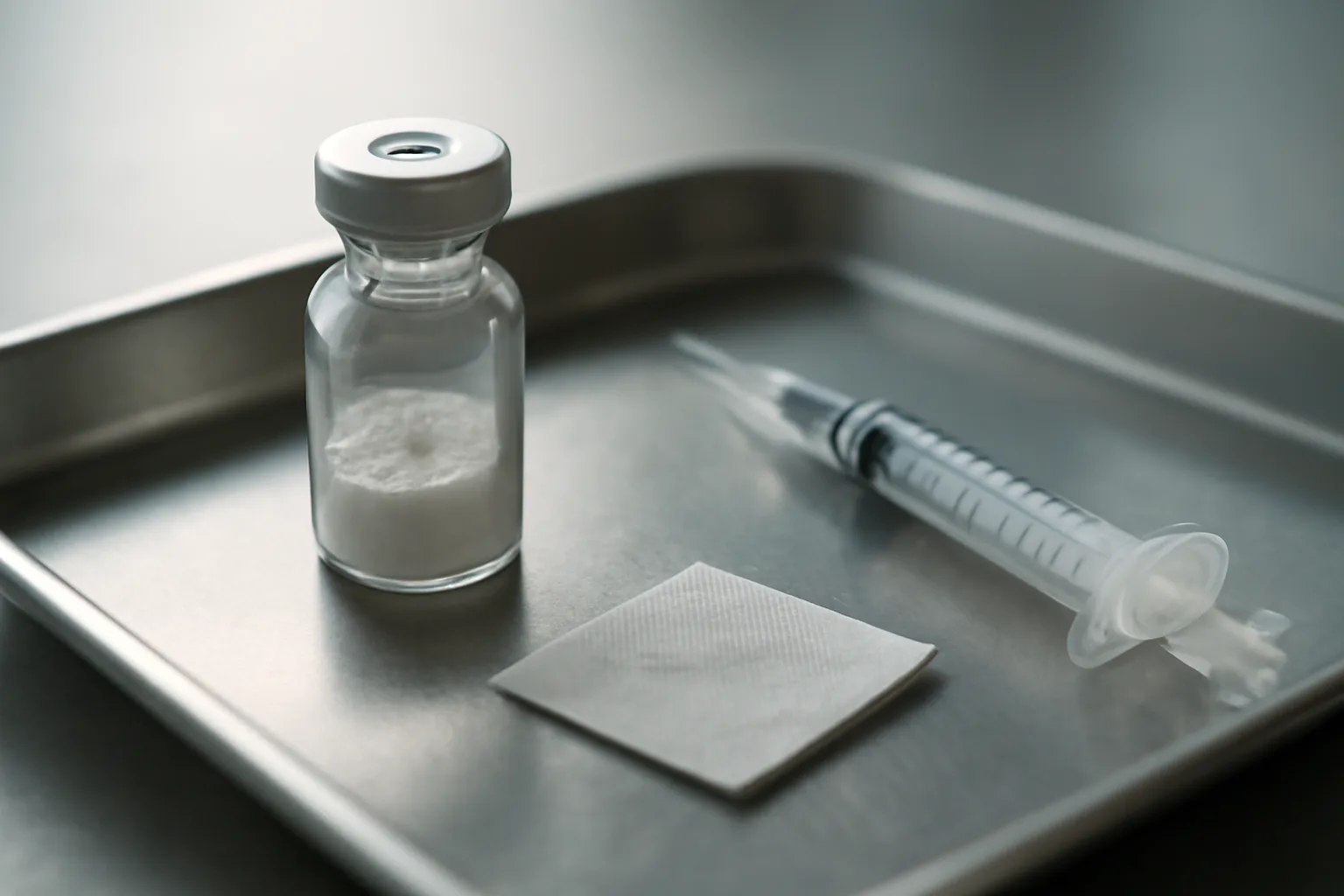
A vial labeled "NAD+ 500mg" tells you the total amount of nicotinamide adenine dinucleotide in that container before you add any liquid. It's a lyophilized (freeze-dried) powder or sometimes a compressed cake sitting at the bottom of a small glass vial. Nothing in that vial is usable until you reconstitute it with a sterile diluent. 500mg is one of the more common strengths compounding pharmacies produce alongside 100mg and 1000mg (1g) options. It sits in a practical middle ground: enough total product for multiple weeks of dosing at typical peptide amounts, without the higher upfront cost of a full gram vial. NAD+ itself is a real, well-characterized molecule. Its structure was worked out decades ago, and researchers have been crystallizing and studying it since at least the 1960s [1]. That's not marketing history, it's basic biochemistry. The compound functions as a redox coenzyme, meaning it shuttles electrons in metabolic reactions, a role documented well beyond a simple energy-carrier description [2]. Because NAD+ compounded for injection or nasal use is not an FDA-approved drug product, it falls under different rules than something you'd find in the Drugs@FDA database [3]. That matters for sourcing, which we get into later.
How do you reconstitute nad+ 500mg
Reconstituting a 500mg NAD+ vial means adding a measured amount of sterile bacteriostatic water (or sometimes sterile water without preservative, depending on what your prescriber/pharmacy specifies) to dissolve the powder into an injectable or sprayable solution. The exact volume you add sets your final concentration, and that concentration is what you'll use to calculate every dose afterward. Here's the math that actually matters. If you add 5mL of bacteriostatic water to a 500mg vial, you get 100mg/mL. Add 2mL instead, and you get 250mg/mL. There's no universal correct volume, it depends on what dose per injection or spray your protocol calls for and how comfortable you are drawing up small volumes accurately. A simple reference table for a 500mg vial:
| Water added | Final concentration | Volume for a 50mg dose | Volume for a 100mg dose | |
|---|---|---|---|---|
| 2 mL | 250 mg/mL | 0.2 mL | 0.4 mL | |
| 2.5 mL | 200 mg/mL | 0.25 mL | 0.5 mL | |
| 5 mL | 100 mg/mL | 0.5 mL | 1.0 mL | Practical steps most protocols follow: wipe the vial top with an alcohol swab, draw the bacteriostatic water into a sterile syringe, inject it slowly down the side of the vial (not directly onto the powder, which can cause foaming), then gently swirl or roll the vial between your palms until fully dissolved. Don't shake it hard. Once mixed, reconstituted NAD+ generally needs refrigeration and is typically used within a defined window, often a few weeks, though exact stability depends on the compounding pharmacy's own testing and labeling, not a universal standard. Always follow the specific instructions that come with your vial rather than a generic timeline, since compounded products vary by pharmacy. If you want to skip manual math entirely, a nad+ injection dosage calculator can save you from a dosing error, which matters more with a concentrated 250mg/mL mix where small volume mistakes have bigger dose consequences. |
What's a typical nad+ peptide dosage per day
Most injection protocols for NAD+ peptide land somewhere between 25mg and 100mg per day, with many providers starting new users at the lower end and titrating up over several weeks. There's no FDA-approved dosing chart to point to here, since this is compounded material, so "typical" reflects common clinical practice patterns rather than a regulatory standard. A few things shape where in that range someone lands. Body weight, whether it's a new user or someone who has been on a protocol for months, and the specific goal (a lot of people start for energy or brain fog, others are following a longevity-focused plan) all factor in. Injection site reactions, flushing, and mild nausea are the most commonly reported side effects, and starting low is the standard way to gauge tolerance before increasing. Frequency also varies. Some protocols use daily dosing, others go every other day, and some use a front-loaded induction period (say, daily for 1-2 weeks) followed by a maintenance schedule of 2-3 times weekly. None of this is standardized across the industry the way a prescription drug's label would be, which is exactly why working with a provider who reviews your specific case matters more here than it would with an FDA-approved product. For a full breakdown of injection-specific timing and site rotation, see nad+ peptide injection dosing guidance.
What is the nad+ nasal spray dosage compared to injection
NAD+ nasal spray dosing is typically measured in milligrams per spray or per metered dose, and total daily intranasal exposure is usually lower than a comparable injected dose because nasal absorption is limited by the small volume the nasal mucosa can absorb per application. A common approach is multiple sprays per nostril, repeated once or twice daily, rather than one large dose. The honest comparison here is about bioavailability, not about picking a winner. Injection (especially subcutaneous or intramuscular) bypasses first-pass metabolism and delivers NAD+ more directly into circulation. Nasal delivery relies on absorption across mucosal tissue, which is convenient and needle-free but generally delivers a smaller fraction of the labeled dose into systemic circulation compared to injection. IV delivery goes further still, putting NAD+ directly into the bloodstream at the infusion rate the provider sets, but it requires a clinical setting and a much longer session (often 1-4 hours). Nobody has published a rigorous head-to-head pharmacokinetic study comparing injected, intranasal, and IV NAD+ bioavailability in humans that would let us give you exact percentage differences. That's a real gap. What we can say is grounded in general pharmacology: routes that bypass the gut and skip first-pass liver metabolism tend to get more of the intact molecule into circulation than oral precursors do, and injectable routes generally allow more precise, higher per-dose delivery than nasal spray. For a side-by-side on comfort, cost, and practical logistics, nad+ nasal spray vs injection covers the tradeoffs in more depth.
How does injectable nad+ compare to oral NMN or NR precursors
Injectable or intranasal NAD+ delivers the finished molecule directly, while NMN (nicotinamide mononucleotide) and NR (nicotinamide riboside) are precursors your body has to convert into NAD+ through several enzymatic steps after you swallow them. That conversion process, plus first-pass metabolism in the gut and liver, means a meaningful fraction of an oral precursor dose never becomes usable NAD+ at all. This is the core route-and-form question most people researching this topic actually have, and the honest answer is that it depends on what you're optimizing for. Oral precursors are cheap, easy to take daily at home, and have more published human trials behind them (mostly small, short-duration studies looking at blood NAD+ metabolite levels, not hard longevity outcomes). Injectable and intranasal NAD+ skip the conversion step and gut degradation, which is the theoretical bioavailability advantage, but they cost more, require needles or a spray device, and have less published human pharmacokinetic data specific to the finished molecule itself. Neither route currently has strong human evidence that raising NAD+ levels, however you get there, extends healthspan or lifespan. What is well established is that NAD+ participates in an enormous range of cellular processes: it's a regulator tied to transcription and has been described as a metabolic regulator of longevity and disease in cell biology literature going back over two decades [4], it plays a documented role in immune cell function [5] [6], and reduced or dysregulated NAD+ handling shows up in kidney stress models [7], cardiovascular disease mechanisms [8] [9], and nonalcoholic fatty liver disease research [10]. That's a lot of biological relevance. It is not the same as proof that supplementing NAD+ (by any route) slows human aging. Recent review literature continues to frame NAD+ biology, transport, and regulation as an active area of ongoing investigation as of 2025 [11], not a settled question with a single best delivery method.
What does the actual longevity and cellular evidence say
NAD+ levels are well documented to decline with age across tissues, and the molecule's biological roles are genuinely broad, but the leap from "NAD+ does a lot in cells" to "boosting it extends human healthspan" is not something the current literature supports with strong human data. Some of the more interesting recent work is happening at the cellular and mechanistic level rather than in human trials. A 2025 study in ACS Nano describes a targeted strategy aimed at senescent cells that recycles intracellular NAD+ to reduce senescence-associated phenotypes, an approach aimed specifically at aging cell biology [12]. That's a preclinical strategy paper, not a human trial, and it's worth being precise about that distinction. Other documented roles for NAD+ span an unusually wide range of systems. It's implicated in neuronal death pathways after ischemic stroke through NADPH oxidase activation [13], in renal stress resistance via PGC-1α signaling [7], in cardiac remodeling and aging processes [9], and even in maintaining pluripotency in human embryonic stem cells through what researchers describe as a bivalent metabolic state [14]. A 2022 cardiovascular disease review in Genes & Diseases lays out molecular mechanisms and therapeutic potential for NAD+ across multiple cardiac and vascular pathways [8]. There's also work in more acute or infectious contexts. NAD+ fluorescence has been studied as a way to assess microvascular disturbances in post-COVID-19 patients [15], and NADPH oxidase inhibition has been proposed as a possible therapeutic angle in sepsis [16]. In oncology, NAD+ salvage pathway dependency (via the enzyme NAMPT) has been explored as a metabolic vulnerability specifically in acute myeloid leukemia [17]. All of that is real, cited, peer-reviewed biology. None of it is a randomized controlled trial in otherwise healthy adults showing that raising NAD+ through injection, nasal spray, or oral precursors adds years to life or measurably slows aging in humans. If someone tells you the science is settled on that point, they're overstating what's in the journals.
Is nad+ 500mg legal to buy, and what does compounding status mean
NAD+ for injection or nasal use is not an FDA-approved drug, so purchasing a 500mg vial means you're buying a compounded product, typically prepared by a licensed compounding pharmacy under a practitioner's prescription rather than sold over the counter as a finished drug. Compounding pharmacies operate under specific federal rules. Section 503A of the Food, Drug and Cosmetic Act, at 21 U.S.C. 353a, governs traditional pharmacy compounding based on an individual patient prescription [18]. Larger-scale outsourcing facilities operate under a related but distinct 503B framework. For a bulk substance to be legally used in 503A compounding, it generally needs to appear on FDA's 503A bulk drug substances list, codified at 21 CFR 216.23 [19], with a parallel list for 503B facilities at 21 CFR 216.24 [20]. FDA maintains a running list of substances nominated for compounding use, which is where regulatory status for ingredients like NAD+ gets tracked and updated over time [21]. What this means practically: legitimate access runs through a prescriber and a compounding pharmacy, not a random online storefront with no medical oversight. If a seller offers a 500mg NAD+ vial with zero prescription requirement and no named pharmacy, that's a red flag worth taking seriously, both for legal compliance and, more importantly, for knowing what's actually in the vial. For a rundown of how legitimate sourcing works, see where to get nad+.
What results should you actually expect, and how do you track them
Most people report feeling effects, when they notice any, within the first one to three weeks of starting a consistent injection or nasal protocol, most commonly described as steadier energy, less afternoon crash, and occasionally improved mental clarity. These are self-reported experiences, not measured outcomes from controlled trials, and individual response varies a lot. Because the human trial evidence for subjective outcomes like energy or cognition specifically from injectable or intranasal NAD+ is thin, the most honest tracking approach is personal and practical rather than clinical. Keep a simple log: dose, route, timing, and how you actually feel over the following 24-48 hours. Note sleep quality and any side effects too. This is closer to how a lot of providers actually help patients titrate dose in practice, since there's no standardized lab test that tells you "your NAD+ therapy is working" the way a blood glucose reading confirms an insulin dose is working. If you want to see what documented user experiences and photos actually show (with the caveat that before-and-after photos are inherently anecdotal and not controlled data), nad+ injections before and after pictures collects that kind of real-world reporting. For the biology of why NAD+ therapy is used at all and how the compound behaves, nad+ peptide is the deeper background piece. At NAD+ Rx, we point readers who are ready to start toward a provider-reviewed injection or nasal spray option rather than an unsupervised purchase, specifically because dose titration and monitoring for side effects genuinely benefit from a clinician who can adjust your specific protocol.
How should you choose a starting dose and titrate up
Start low and increase slowly. That's the practical answer for anyone new to NAD+ injection or nasal spray, and it applies regardless of which route you pick. A reasonable starting point for injection is often in the 25-50mg per day range for the first one to two weeks, watching for flushing, injection site irritation, headache, or nausea. If tolerated well, many protocols step up toward 50-100mg daily or move to an every-other-day schedule at a slightly higher per-dose amount. For nasal spray, starting with the lowest labeled spray count per nostril for the first several days before increasing is the more cautious approach, since nasal tissue irritation is a real and commonly reported nuisance side effect. A few practical rules worth following regardless of route: never combine doses from multiple vials of different concentrations without recalculating your math from scratch, always store reconstituted vials refrigerated and check for discoloration or cloudiness before each use, and don't extend use past the pharmacy's labeled stability window just because there's product left in the vial. If in doubt about your own math, running your numbers through a nad+ injection dosage calculator before you draw up a syringe is a five-minute step that prevents real dosing errors, especially at higher concentrations like 250mg/mL where 0.1mL differences move the dose by 25mg.
Frequently asked questions
How much water do I add to reconstitute nad+ 500mg?
Most protocols use 2mL to 5mL of bacteriostatic water for a 500mg vial. 5mL gives you 100mg/mL, a gentler concentration that's easier to dose accurately in small volumes. 2mL gives you 250mg/mL, more concentrated and requiring smaller draw volumes. Follow your specific pharmacy's instructions, since labeled stability and diluent recommendations can vary between compounders.
What is a typical nad+ peptide injection dosage per day?
Most injection protocols run 25-100mg per day, often starting at the low end for the first 1-2 weeks before titrating up based on tolerance. There's no FDA-approved standard dose since NAD+ injectables are compounded, not regulatory-approved drug products, so amounts vary by provider protocol and individual response.
How does nad+ nasal spray dosage compare to injection dosage?
Nasal spray dosing is measured per spray or metered dose and total daily intranasal exposure is typically lower than injected amounts because nasal mucosa absorbs a limited volume per application. Injection generally delivers more of the dose into circulation directly; nasal spray trades some absorption efficiency for a needle-free, more convenient application.
Is NAD+ 500mg the same product as NAD+ 100mg or 1000mg vials?
Same molecule, different total quantity per vial. A 500mg vial just contains more total NAD+ powder than a 100mg vial, meaning fewer vials needed over a multi-week protocol. The concentration you end up with after reconstitution depends entirely on how much diluent you add, not the vial size alone.
Can I reconstitute NAD+ with regular water instead of bacteriostatic water?
No. Bacteriostatic water contains a preservative (usually benzyl alcohol) that inhibits bacterial growth over the vial's use period, which matters since you'll likely draw from the same vial multiple times over days or weeks. Plain sterile water lacks that preservative and increases contamination risk with repeated use.
Does injectable NAD+ work better than NMN or NR supplements?
It depends on what you're optimizing for. Injectable NAD+ bypasses gut absorption and precursor conversion, the theoretical bioavailability edge, but costs more and needs needles. Oral NMN and NR are cheaper and easier but require your body to convert them into NAD+ through several enzymatic steps, and some fraction is lost to first-pass metabolism. Neither has strong human longevity outcome data yet.
How long does reconstituted NAD+ 500mg last once mixed?
Stability windows vary by compounding pharmacy and aren't governed by a single universal standard, since this is a compounded product rather than an FDA-approved drug with a fixed shelf life on the label. Always follow the specific storage and use-by instructions provided with your vial, and refrigerate reconstituted solution promptly.
Is NAD+ 500mg legal to buy without a prescription?
Legitimate compounded NAD+ for injection or nasal use is typically dispensed through a licensed compounding pharmacy under a practitioner's prescription, following the 503A framework under 21 U.S.C. 353a. Sellers offering it with no prescription and no named pharmacy fall outside that normal legitimate distribution channel.
What side effects should I expect from NAD+ injection or nasal spray?
Commonly reported side effects include injection site irritation, flushing, mild nausea, and headache with injectable use, and nasal irritation or a metallic taste with spray. Starting at a low dose and titrating slowly is the standard way providers help patients gauge personal tolerance before increasing.
Does raising NAD+ levels actually slow aging in humans?
That's not established yet. NAD+ levels reliably decline with age, and the molecule has broad, well-documented roles in cellular metabolism, immunity, and stress response. But no strong human trial has shown that raising NAD+ through injection, nasal spray, or oral precursors extends healthspan or lifespan. Treat longevity claims for any NAD+ route with that caveat in mind.
How do I calculate a specific mg dose from a reconstituted NAD+ 500mg vial?
Divide your target dose by the final concentration to get the injection volume. For example, at 100mg/mL (5mL added to a 500mg vial), a 50mg dose equals 0.5mL. At 250mg/mL (2mL added), the same 50mg dose is only 0.2mL. Recalculate every time you change diluent volume or vial strength.
What's the difference between NAD+ injection, nasal spray, and IV therapy?
Injection (subcutaneous or intramuscular) delivers a set dose directly under the skin or into muscle. Nasal spray delivers smaller amounts absorbed through nasal mucosa, needle-free but generally less efficiently absorbed. IV infusion delivers NAD+ directly into the bloodstream over 1-4 hours in a clinical setting, typically the highest total delivered dose but the most time and logistics involved.
Sources
- PubMed, Journal of Biological Chemistry 1964 (PMID 14245423): Documents early crystallization work establishing NAD+ as a characterized molecule.
- PubMed, Organic & Biomolecular Chemistry 2007 (PMID 18019526): Describes NAD+'s function beyond a simple redox coenzyme role.
- FDA, Drugs@FDA database: Reference for which drug products are FDA-approved, contrasted with compounded NAD+.
- PubMed, Current Opinion in Cell Biology 2003 (PMID 12648681): NAD+ described as a metabolic regulator of transcription, longevity, and disease.
- PubMed, Frontiers in Immunology 2021 (PMID 34912350): Editorial on the versatile role of NAD+ in immune function.
- PubMed, International Journal of Tryptophan Research 2017 (PMID 28659716): Describes tryptophan and NAD+ interactions relevant to immune signaling.
- PubMed, Nephron 2017 (PMID 28591759): PGC-1α and NAD+ role in renal stress resistance.
- PubMed, Genes & Diseases 2022 (PMID 35685463): Molecular mechanisms and therapeutic potential of NAD+ in cardiovascular disease.
- PubMed, Mini Reviews in Medicinal Chemistry 2022 (PMID 35249481): NAD+'s role in cardiac remodeling and aging.
- PubMed, Hepatology 2016 (PMID 26661503): Therapeutic potential of NAD+ for nonalcoholic fatty liver disease.
- PubMed, Trends in Endocrinology and Metabolism 2025 (PMID 39266435): 2025 review framing NAD+ biology and regulation as an active ongoing research area.
- PubMed, ACS Nano 2025 (PMID 40911860): Preclinical strategy targeting senescent cells via intracellular NAD+ recycling.
- PubMed, Neural Regeneration Research 2019 (PMID 30761998): NADPH oxidase activation linked to neuronal death after ischemic stroke.
- PubMed, Stem Cells 2020 (PMID 32003519): NAD+ induces a bivalent metabolism that maintains pluripotency in human embryonic stem cells.
- PubMed, Cardiology Journal 2022 (PMID 34671964): NAD+ fluorescence used to assess microvascular disturbances in post-COVID-19 patients.
- PubMed, Journal of Hypertension 2009 (PMID 19454905): NADPH oxidase inhibition proposed as a possible sepsis therapy angle.
- PubMed, Translational Cancer Research 2026 (PMID 42180876): NAD+ salvage pathway dependency explored as metabolic vulnerability in acute myeloid leukemia.
- Cornell Law School Legal Information Institute, 21 U.S.C. 353a: Federal statute governing traditional pharmacy compounding under section 503A.
- eCFR, 21 CFR 216.23: Bulk drug substances list required for 503A pharmacy compounding.
- eCFR, 21 CFR 216.24: Bulk drug substances list for 503B outsourcing facility compounding.
- FDA, bulk drug substances nominated for use in compounding: FDA's current running list of substances nominated for compounding use, relevant to NAD+'s regulatory tracking.